How to Choose Non-Toxic Flooring for Your Austin Home
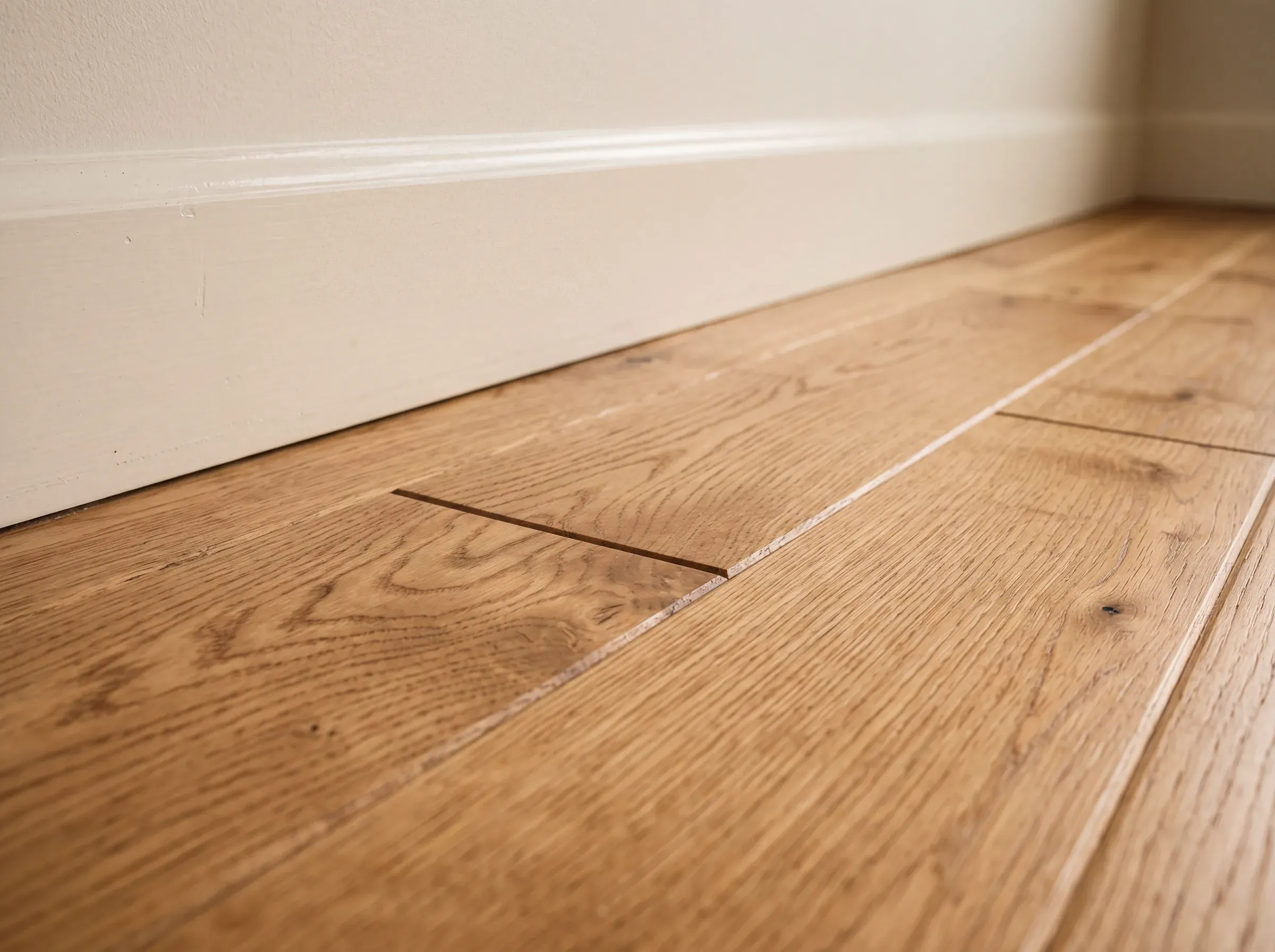
Flooring is the largest surface area in most homes, and one of the most significant contributors to indoor air quality. Yet most homeowners evaluate it almost entirely on appearance and price. Off-gassing from flooring materials, adhesives, and finishes is a real and measurable concern, and the range in air quality impact across common flooring types is wider than most people expect.
The short version: tile and natural stone have essentially no off-gassing concern from the material itself. Solid hardwood, finished with a low-VOC or water-based sealer, is a strong second. Luxury Vinyl Plank varies enormously by manufacturer and product tier, and is one of the most commonly installed floors in Austin remodels. Wool carpet and cork are natural options with low off-gassing profiles when properly finished. Synthetic carpet sits at the other end of the range.
What complicates every category: the installation materials. A tile floor installed with a high-VOC adhesive is not a healthy floor, regardless of what the tile itself does. The full system of material, adhesive, finish, and grout is what actually determines air quality impact. Below is a framework for evaluating each option, including what Austin's climate specifically adds to the equation.
Why flooring is an indoor air quality issue
Off-gassing is the process by which chemical compounds, primarily volatile organic compounds, or VOCs, are released from building materials into the air of a space. Most materials off-gas most heavily in the period immediately after installation, then taper off over weeks to months. The concern with flooring specifically comes from three factors.
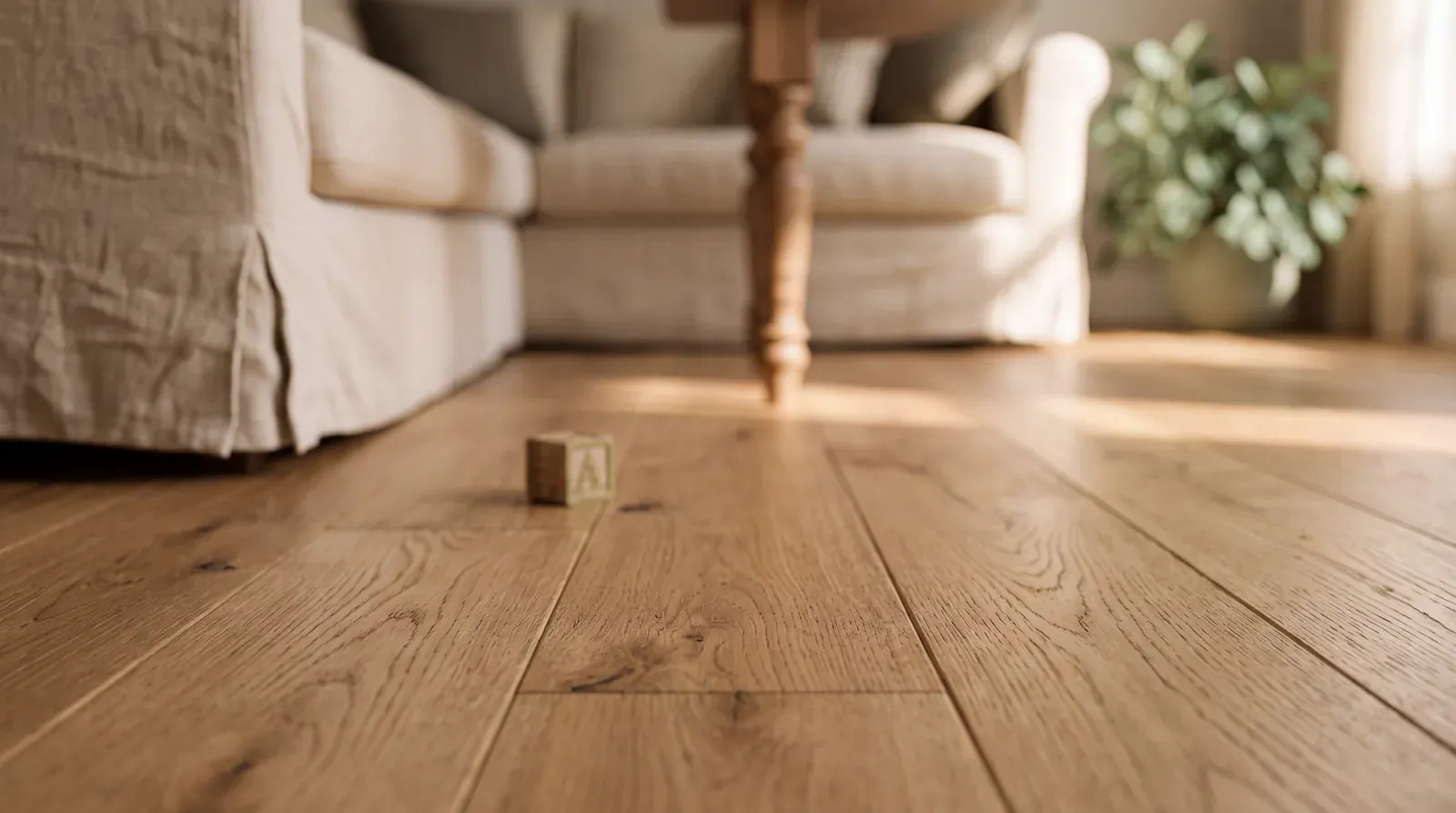
First, flooring has more total surface area than any other material in the home. A 2,000 square foot home has roughly 2,000 square feet of floor, all of it continuously present in the air column of every room. Second, floor-level air quality is specifically relevant for children and pets, who spend far more time at floor level than adults. Third, because flooring gets walked on and abraded daily, the off-gassing period may be extended compared to a wall finish that stays undisturbed.
The most common sources of VOC emissions in a flooring installation are not always the flooring material itself. Adhesives used to glue down LVP or engineered hardwood, finish coats applied over bare hardwood, and even some grout sealers can contribute more to overall air quality impact than the primary material.
The GREENGUARD Gold standard, explained
GREENGUARD Gold, formerly called "Children & Schools" certification, is the benchmark Enso uses when evaluating flooring and finish materials for projects. It is issued by UL's Environment division and requires that products pass rigorous VOC emission testing in a simulated indoor environment, measured across more than 360 VOCs and total chemical compounds.
The Gold tier applies meaningfully stricter limits than standard GREENGUARD certification and was specifically designed for spaces where children, elderly occupants, or others with higher sensitivity to air quality spend time. It is recognized by the U.S. Green Building Council under LEED, and by the WELL Building Standard.
Get the product's certificate number
The spec sheet or packaging should list a UL certificate number. If it isn't displayed prominently, ask the manufacturer or supplier directly, not the flooring installer.
Search at spot.ul.com
UL's SPOT database is the authoritative source. Search by product name or certificate number. Certification is product-specific; a brand can have some certified products and others that are not.
Confirm the exact model number
Verify that the specific model you're specifying appears in the results, not just a related product line. If it isn't listed, it isn't certified, regardless of what the packaging says.
One clarification that matters in practice: "low-VOC" is a marketing term with no universal definition. A product can label itself low-VOC and still emit compounds at levels that would not pass GREENGUARD Gold testing. When in doubt, ask for the certification number and verify it directly, or bring the spec sheet to a 15-minute video call and we'll walk through it with you.
Flooring options, from cleanest to most variable
The table below compares the six most common flooring types in more detail, including certification path and adhesive concern, before installation products are factored in.
| Material | VOC from material | Certification path | Adhesive concern |
|---|---|---|---|
| Tile / Stone | ✓ None from material. Inorganic, inert. | ✓ Grout and sealer should be low-VOC verified. | ◐ Thinset adhesive can vary; specify low-VOC. |
| Solid Hardwood | ✓ Low from bare wood. Finish is the variable. | ✓ GREENGUARD Gold available. Water-based finishes preferred. | ◐ Nail-down avoids adhesive; glue-down requires low-VOC verification. |
| Cork | ✓ Naturally antimicrobial. Low off-gassing from material. | ◐ GREENGUARD Gold on some products. Verify finish and adhesive. | ◐ Adhesive required in most installs; specify low-VOC. |
| Wool Carpet | ✓ Natural fiber, no synthetic off-gassing. | ◐ Green Label Plus (CRI) and GREENGUARD on select products. | ◐ Tack-strip installation avoids adhesive. Pad selection matters. |
| Engineered Hardwood | ◐ Core is the variable; some use formaldehyde-containing binders. | ◐ CARB Phase 2 is baseline. GREENGUARD Gold is the higher standard. | ✕ Most installs are glue-down. Adhesive selection is critical. |
| LVP | ✕ Varies widely. Phthalates and plasticizers in lower tiers. | ◐ GREENGUARD Gold at mid-to-upper tiers. Verify the specific product. | ✕ Click-lock is better; glue-down adds adhesive concern to material concern. |
Certification alone does not resolve the adhesive question for engineered hardwood and LVP. Both variables need to be addressed.
Hardwood: the finish coat is the decision
VOC risk
Low, material only
Certification
GREENGUARD Gold available
Best install
Nail-down, avoids adhesive
Key variable
Finish coat, specify water-based
Bare solid hardwood has a low inherent VOC profile. The choice that matters most is what finish goes on top. Oil-based polyurethane is the most common contractor default; it is durable and inexpensive, but it off-gasses heavily during application and for days to weeks after. Water-based polyurethane and natural oil finishes (like Rubio Monocoat or Bona Naturale) have meaningfully lower VOC profiles and achieve GREENGUARD Gold certification. On an Enso project, the finish is specified in the design phase, not chosen by the flooring installer on install day.
Engineered hardwood: the core material matters
VOC risk
Variable, depends on core
Baseline cert
CARB Phase 2 minimum
Higher standard
GREENGUARD Gold
Austin note
Glue-down over slab, adhesive critical
Engineered hardwood is a real wood veneer over a plywood or composite core. The core is where off-gassing risk lives in lower-grade products, specifically from formaldehyde-containing adhesive binders used in cheaper plywood. The California Air Resources Board (CARB) Phase 2 standard sets a legal emissions floor in California, a baseline worth requiring regardless of your state. GREENGUARD Gold is more stringent. For glue-down installation, which is common on slab foundations, a low-VOC urethane adhesive rather than solvent-based is the right specification.
LVP: Austin's most popular floor, and the one that needs the most scrutiny
VOC risk
Varies widely by tier
Certification
GREENGUARD Gold, mid and upper tiers only
Best install
Click-lock, no adhesive
Austin note
Heat accelerates off-gassing
LVP has become the dominant flooring choice in Austin remodels for understandable reasons: it is durable, water-resistant, looks good, and installs quickly. The air quality range across products is wider than almost any other category. Entry-level LVP often uses plasticizers (primarily phthalates) in the vinyl core and a foam backing that can off-gas independently. Upper-tier LVP products from manufacturers like Shaw, Karndean, and Mohawk carry GREENGUARD Gold certification and have passed independent emissions testing. The critical step is verifying the specific product model in UL's SPOT database, not relying on the product page or the installer's assurance.
Wool carpet: categorically different from synthetic
VOC risk
Low, natural protein fiber
Certification
Green Label Plus (CRI)
Best install
Tack-strip, no adhesive
Watch for
Synthetic backing or foam pad
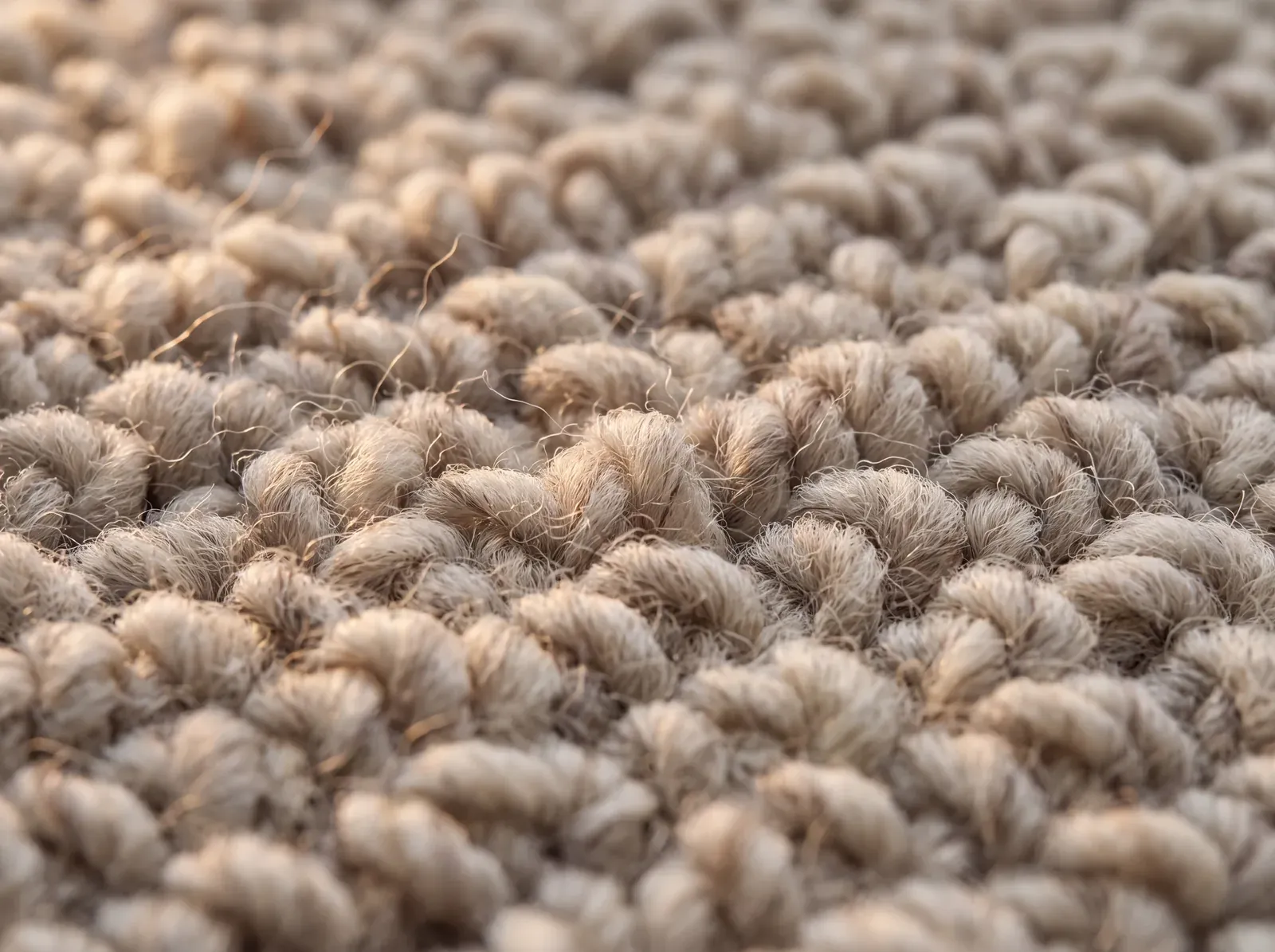
Synthetic carpet, whether nylon, polyester, or polypropylene, is one of the highest off-gassing flooring choices in common use. It is the reason "new carpet smell" is so recognizable. Wool carpet behaves entirely differently: it is a natural protein fiber, naturally resistant to mold and dust mites, and produces no synthetic off-gassing. The caveats are the backing material, which should be natural latex or jute rather than synthetic foam, and the installation pad, which should also be verified. Wool carpet is less common and costs more, but for homeowners who want carpet in a bedroom or living space, it is the right path.
What Austin's climate adds to the equation
Flooring material guidance is often written for a generic North American climate. Austin's specific conditions change the calculus in three ways.
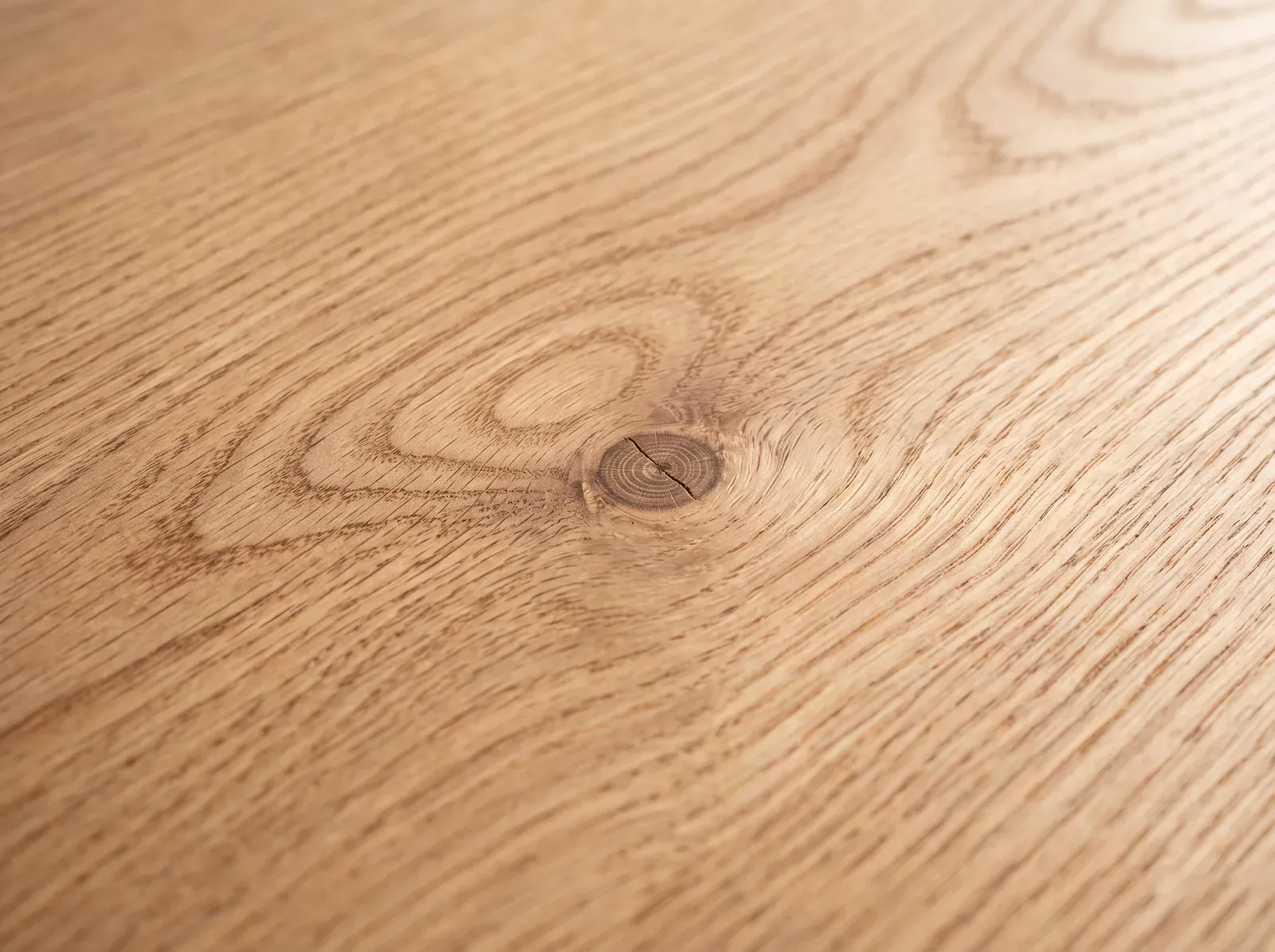
Humidity and hardwood expansion. Austin's roughly 66% average relative humidity, with significant seasonal swings, means solid hardwood expands and contracts more than it does in drier climates. Species selection, acclimation time before installation, and expansion gap sizing all need to account for this. Finishes that flex without cracking are preferable to harder film-build finishes that chip at the seams under seasonal movement.
Slab foundations and adhesive requirements. The majority of Austin homes built after the 1960s sit on slab foundations rather than pier-and-beam. This matters for flooring because glue-down installation over concrete is more common than nail-down over a subfloor. Moisture vapor transmission through concrete slabs, which Austin's clay soil and rainfall patterns can intensify, requires a vapor barrier or moisture-tolerant adhesive system: another material decision that needs to be evaluated for VOC content.
Austin's combination of heat and humidity creates a more aggressive off-gassing environment than most flooring guidance assumes. A new floor installed in a closed, unoccupied home in August can concentrate emissions significantly before move-in, which is why lower-emissions specifications, and ventilation during the first weeks, matter more here than in drier, cooler climates.
The installation materials problem
The most common mistake homeowners make when prioritizing healthy flooring is focusing entirely on the primary material and not the installation system. A GREENGUARD Gold certified LVP floor installed with a solvent-based adhesive is not a healthy floor. The adhesive contributes VOCs independent of the flooring product's certification.
The installation system has three components that each need to be evaluated:
The adhesive
The most frequently overlooked variable, and unavoidable in Austin's glue-down-over-slab installations.
Solvent-based adhesives are faster and cheaper but off-gas heavily, often more than the floor material itself. The fix: specify a low-VOC urethane adhesive from manufacturers like Bostik, Mapei, or Roberts, decided before installation begins rather than on the day of install.
The finish coat
Oil-based polyurethane is the contractor default, and the highest-VOC option in the category.
Without a written specification, the installer defaults to whatever they use on every job. Water-based polyurethane and penetrating oil finishes achieve GREENGUARD Gold status; the fix is naming one explicitly in the design documents, so the decision happens at the design table rather than the job site.
The grout and sealer
Often treated as afterthoughts even when the tile itself was carefully chosen.
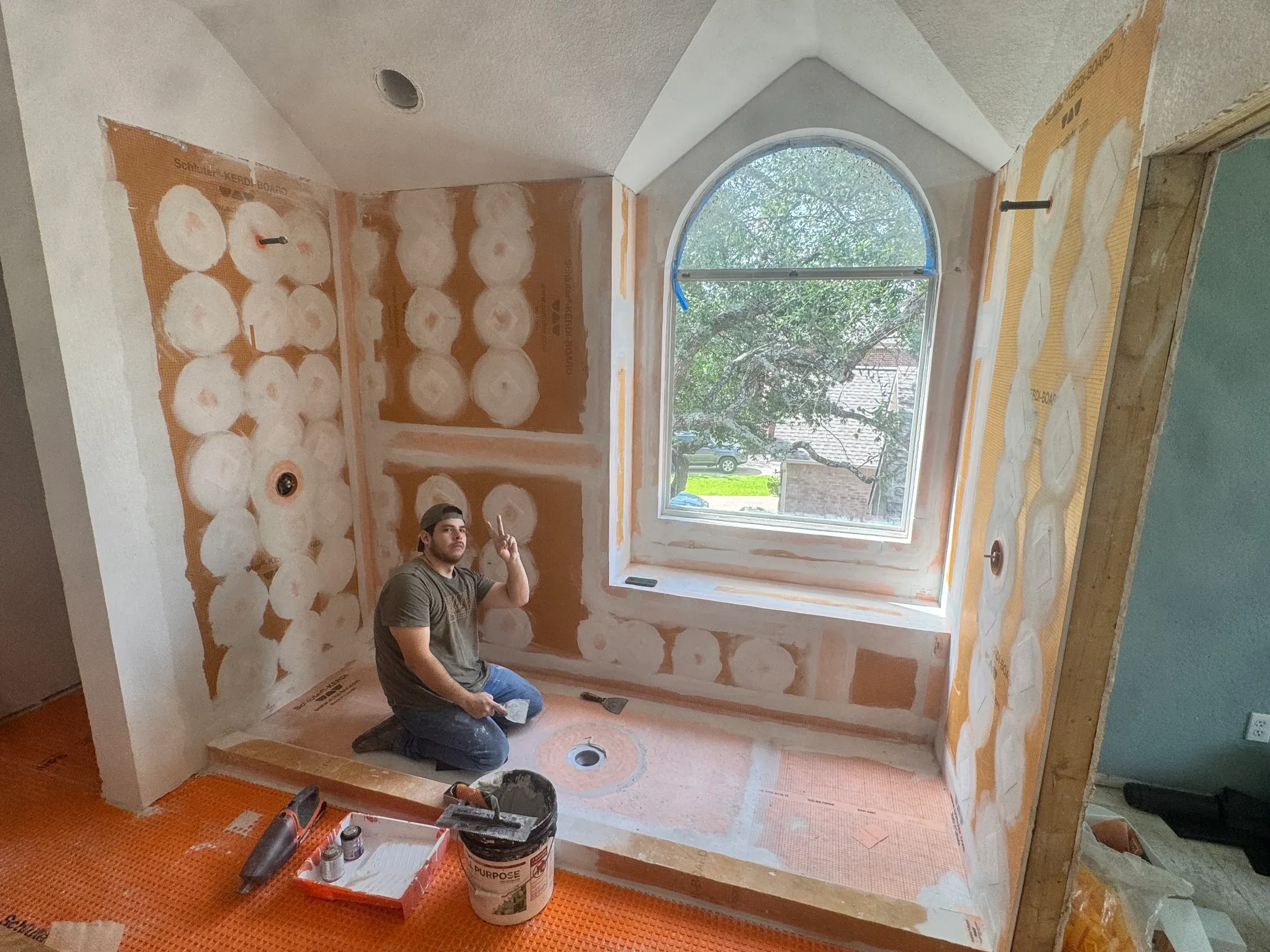
Most cement-based grouts are low-VOC, but penetrating grout sealers vary and some carry significant loads. In wet areas, the fix is waterproofing beneath the tile with systems like RedGard or Schluter KERDI, which does more work than a surface sealer and avoids adding another material variable.
At Enso, the material specification produced during the design phase documents the primary flooring material, the adhesive system, and the finish coat, not just the floor product. The installer receives a complete specification, not a floor sample and an instruction to proceed.
Choosing flooring for a remodel? This happens in the design phase
We help clients navigate material selection, certifications, and installation specs before construction begins.
How to read a product spec sheet for VOC content
Most flooring products at the mid-to-upper tier of the market publish a technical data sheet or environmental product declaration (EPD) that includes VOC emissions data. Here is what to look for when you're reviewing one.
| Term | What it measures | Acceptable threshold | Notes |
|---|---|---|---|
| TVOC | Total volatile organic compounds, in µg/m³ | GREENGUARD Gold limits vary by compound. Ask for 28-day values. | Initial readings are always higher. Look for 28-day simulated room data, not chamber tests at day one. |
| Formaldehyde | The most regulated individual compound, tested separately | GREENGUARD Gold: ≤7.3 ppb | CARB Phase 2 allows 0.05 ppm for composite wood, a weaker standard. The lower the number, the better. |
| Test standard | The protocol used to measure emissions | California Section 01350 or EN 16516 (room-based) | ASTM E1333 is a chamber test, not a room simulation. Results are not directly comparable to room-based protocols. |
| Cert number | The UL certificate ID for GREENGUARD Gold claims | Verify at spot.ul.com | Certification is product-specific. Confirm the exact model number, not just the brand or product line. |
Thresholds apply to GREENGUARD Gold certification. Always request the test report for the specific product, not a summary sheet; the full report shows compound-by-compound measurements.
If a product doesn't publish a data sheet with emissions data, that is itself a data point. Manufacturers of low-emissions products typically make the information easy to find because it is a selling point. If you have to ask twice, look at alternatives that are more transparent about their testing.
The full material picture, which also covers paints, insulation, and adhesives, is outlined on Enso's healthy materials page. For projects involving kitchen remodeling or bathroom remodeling, flooring and tile selection are a significant part of the design phase conversations, and natural materials like hardwood, stone, and cork also serve the broader intention of biophilic design. If you're budgeting a project around these materials, the cost calculator returns a range in about two minutes.
Frequently asked questions
The primary questions, what the healthiest flooring is and how certification works, are answered above. These are the leftovers homeowners ask most often.
LVP varies enormously. Lower-tier products can off-gas phthalates and other plasticizers from the vinyl core and backing. GREENGUARD Gold certified LVP has passed independent testing for emissions and is a meaningfully safer choice. Always verify that the specific product, not just the brand, carries the certification in UL's SPOT database. A click-lock installation with no adhesive also removes the adhesive variable.
We handle the full specification
Material, adhesive, finish, certification: all documented in the design phase before a floor is touched. You'll leave with real next steps, whether or not we build together.